Sugar from a soldier
My grandmother remembered that, when she was a child, Japanese soldiers gave sugar or sweets to local children in Liu Yuan, a village in wartime Guangji County, Hubei. I wanted to know whether surviving records could place that memory inside documented history.

The place in her memory
The village is 刘元村刘元垸, now in Dajin Town, Wuxue City. During the war it belonged to Guangji County. Earlier research places Liu Yuan near the Dajinpu–Tashuiqiao–Jiulongcheng–Lianglukou corridor, west of Huangmei and north of the Yangtze port at Wuxue.
The archival problem is scale. Japanese operational files usually name counties, towns, roads, rivers and military objectives, not every small settlement. Searches using 刘元垸 / 劉元垸, 大金铺 / 大金鋪, and 塔水桥 / 塔水橋 have not yet produced a verified Japanese record naming the village itself. Similar-looking search results for Jiulongcheng and Lianglukou often refer to different places.
What the records establish
- Direct regional evidence
On 15 August 1938, the Japanese 11th Army issued a logistics plan for an advance from Huangmei toward Guangji. It identifies the 6th Division and treats Guangji as an operational objective.
- Independent contemporary evidence
A United States diplomatic report dated 28 September 1938 recorded Japanese naval landing forces at Wuxue on 17 September.
Foreign Relations of the United States, 1938, volume IV, document 652
- Direct regional evidence
A Japanese artillery regiment produced a detailed report, with maps and diagrams, for the Tianjiazhen and Wuxue battle zone between 15 September and 5 October 1938.
- Direct county-level evidence
A subsequent report explicitly covers combat in Guangji during the Wuhan campaign, 17–22 October 1938.
- Later occupation evidence
A postwar Japanese unit history records that Independent Infantry Battalion 216 moved to Wuxue, Guangji County, on 7 February 1944.
- End-of-occupation evidence
Japanese naval surrender inventories from October 1945 list equipment, boats, fuel, ammunition, communications gear, buildings and provisions at Wuxue. They show that a substantial military establishment remained there at the end of the war.
Together, these records establish Japanese military movement into Guangji and Wuxue in 1938, later guard and garrison activity, and a continuing Japanese presence through surrender in 1945. They make an encounter between local children and Japanese personnel historically possible. They do not tell us which soldiers entered Liu Yuan, on what date, or why one of them offered sweets.
Why sweets appear in occupation memories
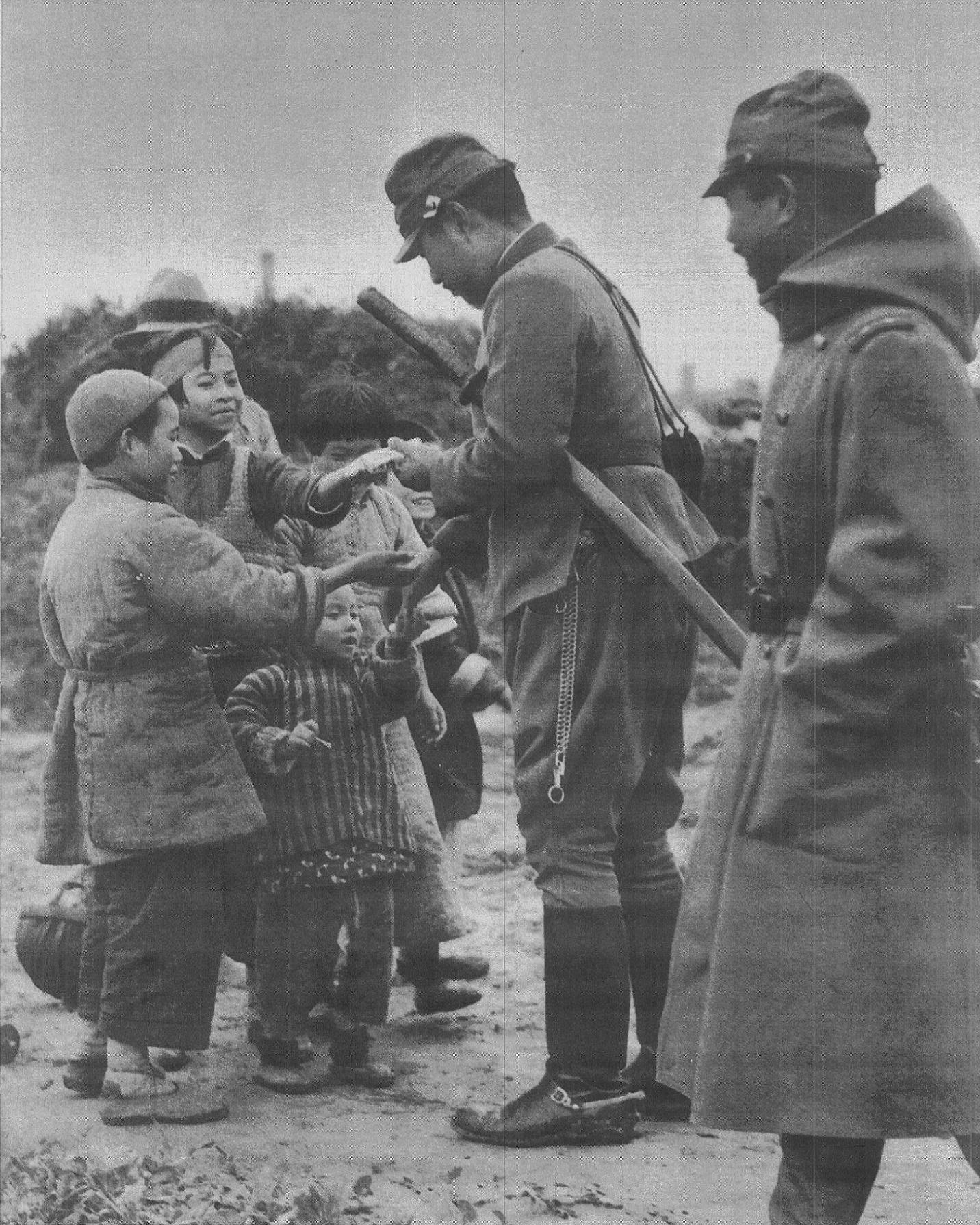
Giving sweets to children was not unique to one village. Japanese wartime photographs and publications repeatedly showed soldiers or pacification personnel interacting gently with Chinese children. These images helped represent military occupation as benevolent. Formal Japanese military guidance also treated propaganda and 宣撫—pacification—as organized work.
A surviving photograph made in Jiangnan on 6 November 1937 is captioned as Chinese children happily receiving caramels from a Japanese military officer. A scholarly study of occupation imagery reproduces another contemporary photograph captioned “Japanese soldiers handing out sweets to Chinese children.” The image appeared within a visual environment that selected or staged reassuring scenes while violence and coercion continued around them.
- Hamano Yoshio, Chinese children receive caramels, 6 November 1937
- Gary Evans, “The Nanking Atrocity: Still and Moving Images 1937–1944,” 2014
- Japanese Army, Propaganda and Pacification Reference Handbook, September 1939 — JACAR C11110463100
- JACAR exhibition of the Cabinet Information Department’s Shashin Shūhō, 1938–1945
A remembered gift can therefore have more than one meaning. It may have been a spontaneous gesture by an individual soldier. It may have happened during a patrol, rest stop, village inspection, transport movement or organized pacification visit. Personal kindness and an occupying army’s propaganda system are not mutually exclusive.
What the evidence does not prove
- No located primary document yet says that Japanese soldiers distributed sugar in Liu Yuan.
- No located photograph depicts Liu Yuan, my grandmother, or the soldiers she encountered.
- The Jiangnan photograph proves that such scenes occurred and were publicized elsewhere; it cannot identify her event.
- The surviving military records describe operations and institutions more readily than children’s ordinary experiences.
- Her age at the time remains necessary to distinguish the 1938 advance from later occupation years.
My conclusion so far
My grandmother’s memory is historically plausible and fits a documented pattern: Japanese forces were present in the Guangji–Wuxue area, and Japanese soldiers or pacification personnel elsewhere gave sweets to Chinese children and publicized similar encounters. But the responsible conclusion stops there. The archive supplies context, not confirmation of her individual moment.
That limitation is part of the history. A child could remember the taste of sugar for a lifetime while the military archive recorded divisions, supply routes and ammunition. The memory preserves a scale of experience that official records usually leave out.
Next evidence to look for
- Her approximate birth year, age, season, wrapper, setting, and whether interpreters or local officials were present.
- Other accounts from siblings, cousins or elderly residents of Liu Yuan.
- The 6th Division’s detailed narratives and scanned map attachments for the Guangji advance.
- Japanese soldiers’ diaries, regimental histories, photographs and guard-duty records using nearby landmarks rather than Liu Yuan.
- County gazetteers, local historical collections and family genealogies used carefully to bridge village geography to the Japanese operational record.